Прием статей в выпуски журнала 2026 г. закрыт досрочно
в связи с поступлением значительного количества статей.
Редакция принимает статьи на 2027 г.
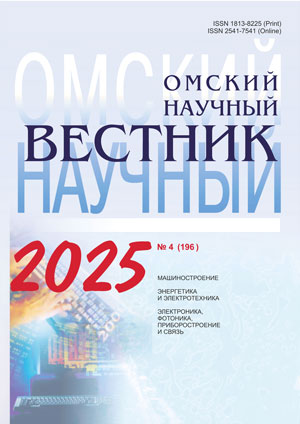
Omsk Scientific Bulletin is the periodical scientific edition registered as mass media. Certificate of registration media is PI No. TU55-00559" dated on 06 October 2017 and issued by the Federal Service of Supervision in the sphere of information technologies and mass communications (Roskomnadzor).
The journal is aimed at publishing advanced scientific research in the fields of mechanical engineering, energy, electrical engineering, electronics, photonics, instrumentation and communications and is addressed to researchers, analysts and practitioners, as well as a wide range of readers who are interested in scientific activities on the subject of the journal. The purpose of the journal is to inform the scientific and technical community about fundamental and applied research; to discuss controversial issues on mechanical engineering, electrical engineering, energy and instrumentation and related fields of knowledge on the pages of the publication.
The journal is included in the List of peer reviewed scientific journals published by the Higher Attestation Commission in which major research results from the dissertations of Candidates of Sciences (Cand.Sci.) and Doctor of Science (Dr.Sci.) degrees are to be published in the following scientific specialties and their corresponding branches of science:
2.2. Electronics, photonics, instrumentation and communications
2.2.4. Instruments and methods of measurement (by type of measurement) (technical sciences)
2.2.5. Navigation devices (technical sciences)
2.2.6. Optical and optoelectronic devices and complexes (technical sciences)
2.2.8. Methods and devices for monitoring and diagnosing materials, products, substances and the natural environment (technical sciences)
2.2.9. Design and technology of instrumentation and radio-electronic equipment (technical sciences)
2.2.10. Metrology and metrological support (technical sciences)
2.2.11. Information-measuring and control systems (technical sciences)
2.2.12. Devices, systems and products for medical purposes (technical sciences)
2.2.13. Radio engineering, including television systems and devices (technical sciences)
2.4. Energy and electrical engineering
2.4.2. Electrotechnical complexes and systems (technical sciences)
2.4.3. Electric power industry (technical sciences)
2.5. Mechanical engineering
2.5.1. Engineering geometry and computer graphics. Digital product lifecycle support (technical sciences)
2.5.2. Mechanical engineering (technical sciences)
2.5.3. Friction and wear in machines (technical sciences)
2.5.4. Robots, mechatronics and robotic systems (technical sciences)
2.5.5. Technology and equipment for mechanical and physical-technical processing (technical sciences)
2.5.6. Engineering technology (technical sciences)
2.5.7. Technologies and machines for forming (technical sciences)
2.5.8. Welding, related processes and technologies (technical sciences)
2.5.9. Methods and devices for monitoring and diagnosing materials, products, substances and the natural environment (technical sciences)
2.5.22. Product quality management. Standardization. Organization of production (technical sciences)
All scientific articles submitted to the Editorial Board of the Omsk Scientific Bulletin are subject to obligatory double-blind peer review.
The journal is established by the Omsk State Technical University and the Omsk State University of Railway Transport. The publisher of the journal is the Omsk State Technical University.
The journal has ISSN 1813-8225 (Print), ISSN 2541-7541 (Online). Omsk Scientific Bulletin is published regularly by 4 issues per year. The paper submission is on the website and by e-mail onv@omgtu.ru. Free of charge content.
Omsk Scientific Bulletin looks forward to cooperating.
Current issue
MECHANICAL ENGINEERING
This article describes a method for constructing a parametric solid based on a framework consisting of a set of curved hexagonal portions whose opposite boundaries of non-rectangular quadrilateral faces have different parametric lengths. Parametric solids can model both the shape and anisotropic interior based on a given framework without transforming it or duplicating its information. Equations for body portions of types r0, r1, and r2 are presented, constructed using non-uniform linear interpolation, to determine initial or boundary conditions in numerical simulations. A three-dimensional computational mesh with variable cell size is created by dividing the body portion into elements whose size is determined by local requirements. This approach, in demand in computational aerodynamics, heat and mass transfer, and other engineering calculations, enables greater accuracy in areas where parameters change rapidly, while simultaneously optimizing the use of computational resources by using larger cells in areas with smooth changes. The wellknown Coons portion equation for a unit cube is a special case of the obtained equations.
The article is a continuation of the study of dynamic dependencies between force and depth of introduction of conical indenters into barriers. The indenter is a cylinder with a pointed conical part. Indenters and barriers are made of steel. As a result of digitization of graphs of investigated dependencies, interpolation formulas of distribution of energies of elastic and plastic deformations in contact zone are obtained. Unlike the previous publication, which considered three variants of the angle of sharpening of the conical head part of the indenter, in this work the range of change of these angles is significantly increased.
The obtained results can be used in the design of composite many rod punches and matrices for pressure treatment of sheet materials, as well as in the development of power and geometric parameters of impact tools for hydromolots.
The article explores the impact of the level of geometric detail on the accuracy of modeling physical processes over a digital twin of high-tech facilities. A miniature subsonic wind tunnel is used as an example. The authors have conducted a series of computer simulations with pipe models, varying in the degree of detail: from simplified to the most detailed. By comparing the results of these simulations, the researchers aim to determine the optimal level of model detail to create the most accurate digital twin. The findings are planned to be used to make practical recommendations on the selection of suitable geometric models for the creation of digital twins intended for aerodynamic research. Thus, the aim of the work is to establish the relationship between the complexity of the geometric model and the accuracy of the results of modeling aerodynamic processes in a digital twin. The more accurate the model, the more computing resources will be required, so finding the optimal balance between accuracy and computational efficiency is a key research objective.
The paper describes a generalization of the Weingarten formulae to find the partial derivatives of arbitrary order of a unit surface normal vector at a given point on a parametric surface. It also proposes methods for computing the normal vectors and its partial derivatives at singular points on the parametric surface. It considers the singular points where two surface base vectors in the tangent plane of the surface are linearly dependent or where at least one of them is zero. It provides algorithms for calculating the normal vectors and its partial derivatives at regular and singular points. This algorithm can be used in computer-aided design and manufacturing systems and integrated into geometry libraries for working with offset surfaces or their generalizations, the description of surface growth processes, the generation of tool paths for numerical control machining applications, geometric modeling of changes in surface shape when multilayer fabric draping, filament winding and tape laying, and access space representations in robotics.
The article discusses a methodology for selecting the optimal composition of technological equipment for production areas of machine-building enterprises. The methodology includes the development of an algorithm that takes into account technical and organizational aspects of production. Using the example of the “Fork” part, the article demonstrates the selection of milling equipment taking into account technological preparation, machine placement, and production organization. The methodology takes into account the flow of production, minimization of motions, efficient use of space, service support, and personnel qualifications. The algorithm provides a comprehensive assessment of production processes, including equipment utilization, economic indicators, and organizational requirements. The main focus is on optimizing capital investments while maximizing productivity. The application of this methodology allows you to improve technical and economic indicators, optimize processes, improve working conditions, reduce costs, and increase productivity.
Smoothly blending two curves is one of the fundamental and complex problems of geometric modeling in computer-aided design systems. This article proposes a method for constructing a smoothly blended curve between two spline curves of arbitrary format and arbitrary degrees, ensuring an arbitrary degree of smoothness.
The formula of the method is as follows: the conjugation points on the original curves are fixed, then the spline segment of the first curve is fixed before the conjugation point, which will become the initial segment of the conjugation spline curve, as well as the spline segment of the second curve after the conjugation point, which will be the final segment of this curve. These fixed segments of the fillet areas are converted to the format of a rational Bezier curve, after which the degrees of these curves are converted to a single specified value by increasing the degree, while the geometry of the curves does not change. Next, the B-polygons of the Bezier curves are transformed into an open S-polygon without changing the geometry. In the next step, an S-polygon of the blend curve is constructed, the end sections of which coincide with the S-polygons of the original sections. Ultimately, an integral rational B-spline blend curve is defined on the open S-polygon.
The end segments of the integral spline blend curve will geometrically precisely match the blend segments of the original curves. The smoothness order of the blend segment with the blend segments of the original curves may be higher than that of the original curves (in the C3D FairCurveModeler application, up to G9 for spline degree 10). In general, the order of smoothness of the integral curve is the same as the lowest order of smoothness of the original curves.
The proposed method for constructing a conjugation is adapted for editing a section of a geometric rational Bezier spline curve.
The article examines the problem of the gap between the detailed results of machine learning in the tasks of quality diagnostics in mechanical engineering and the needs of quality management systems in complex, interpretable and standardized reporting. An intelligent system based on synergistic integration of distributed machine learning modules for local diagnostics and large language models for automatic generation of context-dependent reports of the quality management system is proposed. The methodology, system architecture, algorithms of aggregation of diagnostic information, techniques of engineering of proxies for large language model and mechanisms of verification of generated reports are described, including factchecking for minimization of «hallucinations».
The results of the pilot testing on typical quality control tasks confirm system performance, high accuracy of machine learning modules components and ability to generate factually accurate, relevant and compliant quality management system reports. The proposed approach allows to effectively bridge the gap between technical diagnosis and management needs of quality management system, automating the process of forming intellectual reporting on quality.
ENERGY AND ELECTRICAL ENGINEERING
This article is devoted to the development of a methodology for identifying and suppressing ferroresonance processes in isolated electrical complexes and systems. The development of distribution networks based on the principle of distributed generation allows for the reduction of transmission losses and the organization of electrical complexes and systems isolated from the Unified Energy System. One of the disadvantages of such systems is their lower dynamic stability compared to centralized power supply. Voltage and frequency deviations in isolated complexes and systems can lead to saturation of the magnetic cores of power transformers, resulting in ferroresonance. This issue remains challenging and poorly understood. Therefore, the objective of this work is to develop a methodology for identifying and suppressing ferroresonance circuits in isolated electrical complexes and systems, taking into account the saturation mode of power transformers and deviations in voltage and frequency from their nominal values.
This paper presents the derivation of expressions for calculating the resistance of the magnetizing branch of a power transformer in saturation mode and when voltage and frequency deviate from their nominal values. A method for identifying ferroresonance processes and evaluating control actions aimed at suppressing them based on the amplitude-frequency characteristic of the network is described.
The method is tested using the example of an oil and gas production enterprise's electrical transformer substation. According to calculations, a 12 % load on a 35/6 kV transformer in saturation mode of its magnetic system corresponds to the formation of parallel ferroresonance at a frequency of 47.3 Hz and series ferroresonance at a frequency of 72.2 Hz. The ferroresonant process is damped as the transformer load increases. Detuning the ferroresonant circuit by increasing the capacitance from 13 μF to 26 μF corresponds to a shift of parallel ferroresonance to a frequency 36.4 Hz and series ferroresonance to a frequency of 55.7 Hz.
The article has considered renewable energy sources with high energy potential, which in the near future will become the fastest growing source of electricity. Generation sources include solar, wind, and biomass resources, which contribute to economic growth and reduce pollution. Optimizing the renewable and sustainable energy project is a key factor as a reliable alternative to conventional hydrocarbons, as well as as an energy source. It can play a significant role in the future of renewable and sustainable energy in Iraq. In the work, Helioscope and HOMER Pro software are used to create a small model connected to a network and to estimate energy consumption for optimization purposes. The results have showed an internal rate of return of 12 %, as well as about 8.5 % return on investment, and the share of the renewable energy component is almost 99.7 %. The proposed method proved to be effective in terms of using renewable energy. The research can be applied in any country, especially in the neighboring countries of Iraq.
The article considers the development of a pressure identifier for a pumping unit with an asynchronous electric drive. The widespread use of such installations determines the relevance of this subject.
The purpose of the study is to develop a pressure identifier for a pumping unit as a part of an electrical complex based on neural networks. The current pressure value is calculated using the values of the stator current and voltage of the asynchronous electric motor. In the article under consideration, direct neural networks and nonlinear autoregressive networks with external input parameters are used to determine pressure, in contrast to existing methods for indirectly determining pressure.. Furthermore, to increase accuracy and reduce noise, the values of stator current modules of the electric motor and the value of the stator current voltage module are supplied to the network input.
As a result, the author obtains structures of neural network pressure identifiers with asynchronous electric drives and also determines the sizes of the hidden layers using integral criteria. The article provides comparative pressure waveforms showing the operability of the neuroidentifier.
The article proposes an approach for determining the optimal shape of the pole tips of a salient-pole synchronous machine with electromagnetic excitation, which can be used to ensure a sinusoidal distribution of magnetic induction in the air gap of the machine. In order to analyze the magnetic circuit of an electric machine, a rectangular magnetic circuit is considered, which is transformed using the conformal mapping method into a machine magnetic circuit sector for a pair of poles. As an example, the optimization of the pole tips of a four-pole electrical machine is performed. The magnetic field of such an electric machine is calculated in the FEMM software package, and the distribution curve of the normal component of magnetic induction in the air gap is analyzed.
To ensure the repair and production of asynchronous machines, the creation and development of unified testing systems is an urgent task. The methodology proposed in the article for designing unified test systems allows using efficient and economical ways to create such systems that test various types of asynchronous machines with similar technical parameters.
The existing test systems for the most tests of asynchronous electric machines only based on idling and short-circuit experience, excluding the possibility of conducting heating tests at rated load, limiting testing to indirect methods only, which does not fully reflect the quality of manufacture or repair of asynchronous machines.
The assessment of the technical condition of an asynchronous machine during testing is an important task, the solution of which helps to increase reliability, reduce emergency situations, and reduce the loss of working time associated with unscheduled repairs.
Currently, special attention is being paid to the processes of information technology used in the repair of electric machines and the formation of an electronic passport of an electric machine, the development of digital control systems for technological and technical discipline to eliminate the influence of negative human factors.
The object of the study is an electrical system for testing asynchronous machines. The subject of the research is the principle of construction, modeling and control of an electrical system for testing asynchronous machines.
The article also describes mathematical and simulation models of the developed test system for two mutually loaded asynchronous machines, considering the reaction of the elastic element connecting their shafts.
Optimization of the design of solid oxide electrolyzers is promising for the development of both energy and industry in general. Therefore, research in the sphere of improving the efficiency and reliability of electrolyzers is conducted by scientists around the world. In the paper, the authors consider a change in the design parameters of interconnectors for a solid oxide electrolyzer, which makes it possible to assess the impact of the design on the operating parameters of the existing and newly designed equipment. In particular, special attention is paid to studying the effect of the trajectory of gas channels on the current balance of an electrochemical device. Based on modeling for a solid oxide electrolyzer of a planar design, the authors determine relation between the geometric dimensions of the elements when changing the trajectory of the gas channels of the interconnector and voltage losses during its operation.
ELECTRONICS, PHOTONICS, APPLIANCE AND COMMUNICATIONS
The work focuses on the construction of a single-component spherical electric field strength sensor with an open system of sensitive electrodes, capable of operating in fields of varying non-uniformity with the required error. Spherical shells in the form of hollow spherical segments and their interaction with the electric field of a point source are considered as sensitive electrodes of the sensor. The main theoretical provisions are formed that facilitate the determination of the output signal of the sensor in the form of opencircuit voltage Uxx. The relationship between the output signal of the sensor and its error from the spatial measurement range and from the design dimensions of the sensitive electrodes of the sensor is established. Based on the established relationships, a mathematical model of the sensor is compiled and mathematical modeling is carried out. The result of mathematical modeling are the numerical values of Uxx and the error d from the heterogeneity of the electric field depending on the spatial range a and the angular dimensions of the sensitive electrodes θ0 of the sensor. The graphs of these dependencies constructed using the numerical values revealed that the permissible angular dimensions of the sensitive electrodes of the sensor should lie in the range of 40° ≤ θ0 ≤ 50°. This range provides the sensor with an error in modulus not exceeding δ ≤ 5 %. However, the optimal angular size of the sensitive electrodes of the sensor should be considered to be θ0 ≤ 45°.
A sensor with such an angular size of the sensitive electrodes will have a minimum error in a wide spatial range of measurements and will provide the possibility of creating two- and three-component sensors without overlapping the electrodes. The results of the work can form the basis for evaluation calculations of sensors with an open electrode system.
This article examines the impact of the directional stability of an unmanned aerial vehicles based measuring system on the tilt angle measurements of reinforced concrete supports in power supply systems. A comprehensive solution is proposed, based on the integration of disparate sensors into a single multisensor platform, including 5-axis micro-electromechanical systems accelerometers and gyroscopes, or at least 3-axis ones, a modified system of laser scanning rangefinders used simultaneously as altimeters, satellite navigation system sensors (GPS/GLONASS), airflow sensors, barometric sensors, magnetometers, and a machine vision system. The role of the inertial measurement unit and the “Heads-upright” device as the basis for constructing an inertial navigation system is emphasized.
Examples of calculating relative errors of unmanned aerial vehicles heading deviations in the horizontal and vertical planes when determining the angle of support deviation are provided. An analysis of the proposed system's impact on the metrological characteristics of the measuring system is conducted, particularly when using laser scanning rangefinder with a frequency of 10 kHz and an error of up to 1 mm. Using the proposed technical means allows eliminating these errors when monitoring the geometric position of reinforced concrete structures and supports of railway overhead contact lines.

ISSN 2541-7541 (Online)